Saturday, October 29, 2011

Saving libraries, but not librarians

In an op-ed article in the LA Times, Regina King, an Orange County librarian, laments at how the state of California underfunds and overworks librarians in the state, citing that California has 3,432 librarians for a population of 37 million, roughly 10 thousand people to each librarian. The national average, she states, was six thousand people to one librarian. The state of school librarians is even worse she says, with one librarian to nearly six thousand students; the national average is one to 865.
Photo from the L.A. Times

Public funding for libraries, she states, is at an all-time low after the operation revenue from state sources shrank from 12.8% to 8.7% from 2001 to 2008. The Public Library Fund, a state program that aids libraries individually, has never received its full allocation of funding from the state. Gov. Jerry Brown even proposed getting rid of state funding for public libraries entirely.

Librarians are public employees, but do not have the strong unions that others like firemen or policemen do. Because of that, King says that librarians are much easier to lay off. She cites the Los Angeles Public Library in 2010, when it cut 328 of its full time positions.

Public perception of librarians are also negative, she states. When asking a young student what he thought of librarians, he said, "Librarians check out books. They read a lot. They tell people to be quiet." These misconceptions are held far and wide by all age ranges. Librarians, she states, do much more than that, like run programs, build collections based on their patrons wants, and serve as "the ultimate gatekeepers and organizers of high-quality information."

King later cites national surveys which state that public library attendance has increased 19.7% since 1999, and that losing librarians at this point will compromise library quality dramatically.

The Los Angeles Times

Tuesday, October 25, 2011

Students see piracy as alternative to high textbook prices

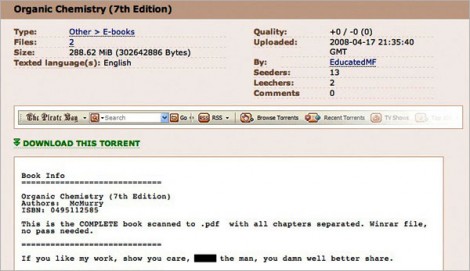
Online piracy, typically associated with the illegal sharing of movies, music and video games, is broadening its horizons with textbooks. The excessive price of textbooks, in addition to the growing ubiquity of tablets and other portable digital media, has driven many a cash-strapped student to illegally download pirated digital copies of textbooks in an effort to save money.

A textbook found on piratebay.org, a popular file-sharing site.
Photo taken from the New York Times.
Cal State Long Beach senior Julie Boll, now nearly $19,000 in debt, found that her textbook costs for the semester would come to nearly $700. With no means of paying, piracy soon became the best option.

"I have paid literally thousands of dollars to [textbook distributors]," Boll told the Daily 49er. "I can't afford to line their pockets this semester, and I don't think they should really blame me."

The textbooks come from a variety of sources: some are hacked versions of official digital copies, allowing for unrestricted copying and distribution, others are uploaded by a determined set of students who physically scan library copies of the textbooks. 

Even some professors are tacitly supporting textbook piracy. "I do not go so far as to provide them with copies, but at the start of every semester, I make it very clear to my students that there are free copies of their $200 textbook on the internet," an anonymous CSULB professor told the Daily 49er.

In response, several major textbook publishers have initiated legal action. Recently, a court found popular file-sharing site Rapidshare liable for hundreds of thousands of dollars in fines for textbooks illegally hosted on their site. Publishers have also threatened students with legal actions if they did not pay a settlement.

Further Reading:
NY Times 

Sunday, October 16, 2011

Traveling Holocaust exhibit visits CSULB library

Opening Ceremony. Photo by College of Liberal Arts, CSULB.
A circle of tall panels stands in a small side room on the third floor of the University Library, dominating the tiny space with vivid photographs and graphic descriptions of the Jewish Holocaust. The atmosphere in the room is somber; there is no idle chatter nor hushed whispers. Visitors make their way slowly around the circle reading each panel, each dedicated to a particular chapter of the Holocaust, starting with the rise of the Nazi Party and coming to a horrific crescendo as the Final Solution reached its most barbaric.

The "Courage to Remember" is a traveling Holocaust exhibit, sponsored by the Simon Wiesenthal Center, first founded in 1991. Three identical exhibits are now making their way across California, stopping at schools, libraries, and other public venues in order to educate and to raise awareness for the Holocaust.

State Sen. Alfred Lowenthal at the exhibit.
Photo by Ashleigh Oldland, Gazettes.
The tour was sponsored by the Foundation for California after receiving a grant from the SNCF, or the Société Nationale des Chemins de fer français, a French railroad company. A panel in the exhibit explains the reasoning behind the grant:

"The role of French Rail in the deportation of the Jews to the death camps rightfully stirs strong emotions, including in the US. Equally, this terrible tragedy continues to motivate SNCF, its board, its managers and its personnel, to support the cause of memory by making public and transparent all of the documents associated with the role of the company during the war."

The exhibit was on display at the CSULB library from September 19 until October 16.


Wednesday, October 5, 2011

CSUN library closes due to potential gunman

The Oviatt Library at California State University, Northridge was closed last Tuesday after university officials were warned of a possible gunman on campus.

CSUN's Delmar T. Oviatt Library
The man, later identified as Gahren Moradian, a philosophy student, made comments insinuating that he was planning to use a gun in the library at around 10 a.m. Tuesday morning. An individual then alerted the police after he or she overheard Moradian. Law enforcement officials then evacuated the library while conducting a thorough search for the suspect, but ultimately found nothing.

Sarkis Mkrtchyan, 24, reported to the Daily Sundial that he saw a man fitting the suspect's description in front of the library screaming that he was "doing a lot, not getting credit for it, and there's no recognition."

Moradian turned himself in at around 8 p.m. Tuesday night and was charged with making criminal threats. He was being held at the L.A. County Central Jail.

The recent weeks have proven tumultuous for students and campus libraries, after a bomb scare evacuated the library at California State University, Long Beach two weeks ago.

Further Reading:
Possible gunman causes closure of CSUN library
CSUN 'gunman' turns himself in to police