Wednesday, November 30, 2011

General Library Statistics

Taken from kempbros.com
I recently interviewed Carol Perruso, the Collection Development Officer and Librarian for Journalism, Social Work and Sociology. Among the things we talked about were statistics about library usage at CSULB during the 2010-2011 fiscal year:

- More then 1.3 million people entered the library, a 23% increase since June 2006, when library renovation began.

- Usage of computers in the Spidell Computer Lab is up 0.4% from last year.

- The total number of items used, both checked out and inside the library, was 517,618 (up 7.2%).

- Usage of online databases reached more than 1.3 million sessions (up 9%).

- Library instruction sessions, which teach students research skills, critical thinking research skills and research technique have increased steadily: 600 instructional sessions per year reaching 11,0000 students.

Taking all this information, we can see that library usage has been increasing steadily in the past few years, despite the fact that college enrollments are presently decreasing. What things are fostering this sort of growth, despite all expectations? This is something I hope to explore in my final project.

Tuesday, November 22, 2011

The library as the new place to be?

 The social life of a college student is typically busy and hectic, and more often than not you can see groups of eagerly chatting students all over the campus. Though in Tom Hiemstra's case, that particular place where he prefers to meet his friends isn't the sort of place that is usually associated with lively conversation and carefree social freedom.

Photo by Amanda Lam
Tom is a junior Chemical Engineering major at the University of Nebraska, Omaha.

"The library wasn't really a place I thought I could hang out," he said. "You think library, you think stuffy old book collection or some sort of hushed museum, not a place where you can spend hours just talking."

Over the course of his college education, Tom believes that he spent most of his free time in the library, as opposed to trendy coffee shops, school food courts, or even in designated recreation areas. Libraries in the past few years, have changed in that they are no longer just a book repositories, but rather entirely new entities. Referred to as library as place, the phenomenon has seen the role of the library go from a storage place of knowledge to an actual community, where people can go to socialize and relax in addition to study.

Tom noticed parallels with other more conventional hang out spots. "I work as the assistant manager at a local coffee shop and I see people in the library do exact same things in my shop. They break out their laptops, they rearrange chairs so they can fit more people at a table and they end up just having a good time with their friends."

Wednesday, November 9, 2011

Police reports man caught masturbating in library

A man was caught masturbating on Oct. 17 in the University Library, though the woman who saw him did not report the incident to the police until the following day. The suspect currently remains at large, and is described as being in his 30s, wearing frameless glasses, a black t-shirt and khaki pants, reported University Police Captain Scott Brown.

In a currently unrelated incident, a woman contacted the police after receiving disturbing phone calls coming from a campus phone number. The same number would call her phone a few times a day over the course of a couple of weeks. Police were unable to track the number because of the uniform number displays for department lines.

"It's really disturbing how we still have to deal with things like this," said junior Political Science major Stanford Swanson. "You figure it'd happen somewhere else, not here."

Daily 49er

Friday, November 4, 2011

Librarians in the information age (A rebuttal)

In a response to an op-ed that I covered last week on the under-appreciation of librarians, Dan Terzian, a fellow at the legal clinic New Media Rights, claims that libraries and librarians have to adapt and conform to the "digital revolution."

Terzian opines that the revolution has "made many librarians obsolete." Traditionally, librarians provided valuable services that advised research and guided information seekers, but now with the advent of the internet and Google, those services are slowly being taken over by automation and digital sources he said, citing Google Books and Google Scholar as examples. For many college students, he states, Google is the first and last information searcher they need.
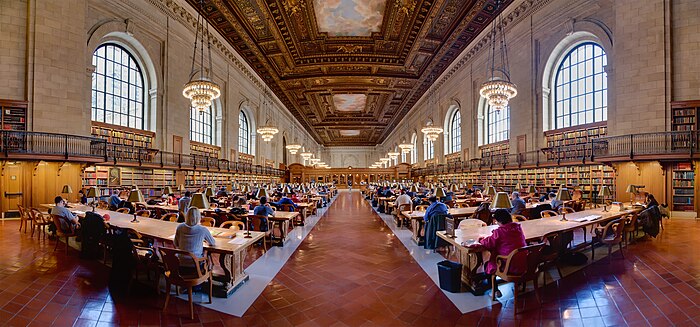
The New York Public Library, photo by David Iliff

Terzian states that the revolution should "spark library evolution." Classically trained librarians have a place in academia and university settings, but are largely obsolete in public libraries. He suggests that the role of librarians in public libraries should be taken up by English or other liberal arts majors who are attracted to the "literary librarian lifestyle." These new librarians wouldn't safeguard information, he claims, rather they would "teach patrons basic research in the information age."

He does acknowledge that librarians have been hit hard by budget cuts, but attributes it not to the specific targeting of libraries for budget cuts, but rather just the entire public system needing to tighten its belt. Others have been hit just as hard, he states, like public university students and other state employees.

He calls for innovation in libraries and cites the New York Public Library as an example, with its "digital strategy -- including e-publications, crowd-sourcing projects and a user-friendly online library catalog." He points out that with these achievements, the library actually makes more money than it spends.


Los Angeles Times